
Food Safety

Your Cold Chain is Aging 2x Faster than Necessary. Here’s the Proof.

Stop Accepting Decay as a Cost of Business: Your FSMS has an Unchecked, Multi-Million Rand Loophole.

If your facility only reacts to surface swabs and cold chain data, your food safety protocols are negligent. That is not hyperbole.

Right now, a silent, chemical aging hormone is flooding your cold storage, actively attacking the organoleptic integrity and safety margins of your perishable foodstuffs—from premium meats to delicate produce. You are effectively paying a multi-million rand monthly “tax” on accepted decay, simply because Conventional Food Safety protocols don’t see the threat until it’s too late. This cultural acceptance of shrinkage is not a “cost of business”; it is an unchecked failure of operational integrity.

We call it “Inherent Vice.” You should call it a crisis.

Conventional utilities cannot stop this invisible deterioration. Chemical fogging leaves residue. Ozone is unsafe. Blue light is a surface utility with no penetration power. These are not professional risk-engineering tools; they are outdated operational compromises.

Re-engineering the Equation: Volumetric Atmospheric Integrity

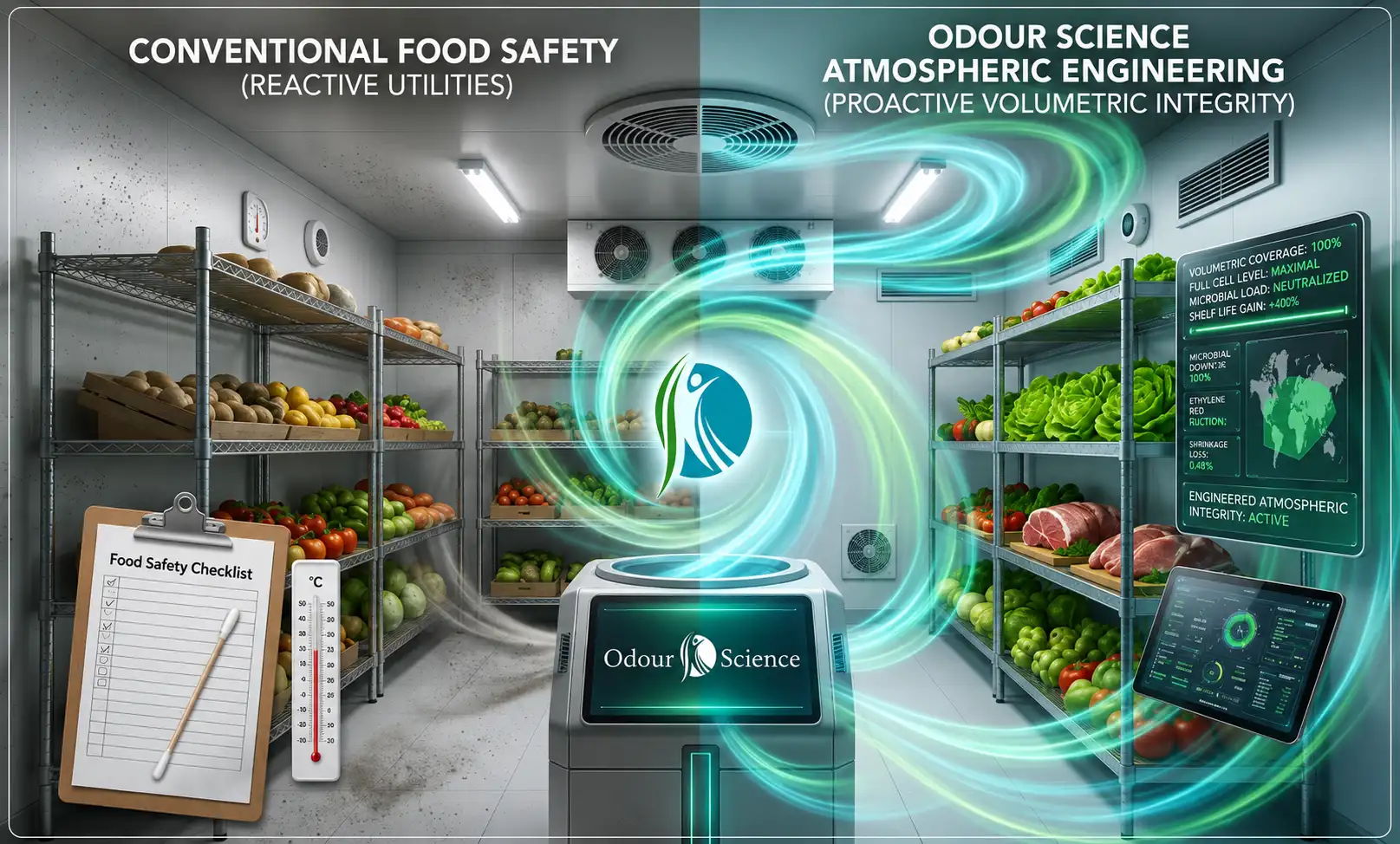
To protect foodstuffs integrity, standard utilities must transition to authenticated environmental engineering. You must protect the atmosphere itself, volumetrically, ensuring integrity guaranteed from the core to the crate.

At Odour Science, we have spent a decade developing Atmospheric Engineering platforms with world class scientists, specifically designed to manage airborne contaminants, odors, and ethylene accumulation inside controlled environments. This is a proactive paradigm shift.

Our platform is built around sustained-release gas-phase technologies engineered for controlled environments, drawing on globally recognised advancements in chlorine dioxide atmospheric applications.

Closing the ‘Vice’ Loop: Authenticated Outcomes

This system is an engineered tool for proactive risk mitigation. It is designed to be integrated into an advanced Food Safety Management System (FSMS), explicitly closing the logistical and operational risk loops that swabs and sensors cannot address. It continues to work, volumetrically, even if standard refrigeration equipment possesses brief failures.

The rigorous outcome has been documented across active operational environments:

  • Continuous, volumetric protection: Ensuring every node of your cold room possess environmental integrity, from JHB to CPT, or across a cross-border reefer node.
  • 30-40% operational lift in shelf-life extension: Directly improves product quality consistency, reduces claim frequency, and eases replenishment stress.
  • 99.9% microbial load reduction: Providing non-residue protection that conventional cleaning cannot match.
    Atmospheric integrity inside a cold room creates operational stability and margin protection outside of it.

If you manage high-volume perishable goods, your portfolio is likely already paying an “Inherent Vice tax”—compromising your margins and your FSMS integrity. Stop accepting decay.

The food safety model of the future doesn’t wait for a swab to fail. It engineers the failure out of the atmosphere entirely.

Does your FSMS possess engineered atmospheric integrity?